Acid/pH Adjustments
By Bill Collings (Revised August 1, 2007)
Every winemaker, at one time or another, has had to deal with grapes having less than ideal pH and acid balances. Whether the grapes come from California, a warm climate, or Oregon, Washington and the Okanagan, cool climates, the winemaker is faced with the problem: how to adjust the acid and pH.
It may be necessary to adjust the grape acid level for different reasons:
- The pH is too high and the acid too low;
- The pH is too low and the acid is too high; or
- Both the pH and the acid are too high, usually the result of excessive amounts of malic acid and potassium.
Both 2 and 3 are phenomena common in cool climate grapes; although 3 occurs in warm climate grapes also.
Before continuing, it must be pointed out that when Total Acidity (TA) is referred to it will be in grams per litre. Some books refer to acid as a percentage: ie – 0.7 percent. To make the transition to grams per litre, move the decimal one space to the right; thus 0.7 becomes 7 grams per litre.
All white and rosé musts should be adjusted to a maximum of pH 3.3 and all reds should be adjusted to a maximum of pH 3.4 in order to achieve optimum flavour extraction and to minimize bacterial infection. These adjustments should be made with tartaric acid. Even if this procedure increases the TA above desired levels, the tartrates can be precipitated with cold stabilization. The rule-of-thumb for tartaric acid addition is 1 g/l to reduce the pH by 0.1. However, there are some cautions:
- Different grapes have different buffering capacities;
- High pH drops, say from 3.6 to 3.3 may require about 4 g/l of tartaric acid instead of the rule-of-thumb 3g/l as the ratio is on a curve rather than being linear;
- Adding acid can result in some precipitation of potassium hydrogen tartrate (KHT) which may affect both pH and TA values. Therefore, lab tests should be performed.
The most convenient way of testing for the appropriate amount of tartaric acid to add is to prepare a 10% solution (10 grams in 100 ml of water) of tartaric acid in distilled water. Dissolve the acid in a little water and add water to exactly 100ml. Set up several glasses containing 100ml of juice and, using one as a control, to the other glasses add 1, 2, 3, etc. ml of the 10% solution and measure the pH changes. The volumes of the 10% solution used are equivalent to the grams per litre of acid necessary to make the required adjustment. That is, one ml of the solution equals one gram of acid. The same process can be used if post-fermentation acid adjustments need to be made. By using the 10% solution, results are instantaneous and less bothersome than dissolving the acid volumes one at a time.
Be aware that all the acids – tartaric, malic and citric – will affect the TA values differently. While a one-gram addition of tartaric acid will increase the TA by one gram per litre, malic acid will increase the TA by about 1.12 and citric acid by about 1.17. They also affect the flavour differently. So lab tests are essential.
Whether the grapes are pressed immediately after crushing or let stand on the skins for flavour extraction before pressing, once the juice sample has settled and cleared, the acid and pH readings should be accurate. The same cannot be said for red grapes, however. Most winemakers take their samples immediately after crushing, but the readings are not accurate. Doing a test twenty-four hours later will see an increase in pH of between 0.1 and 0.2 as the direct result of potassium extraction. The TA change will be minimal. A further increase in pH will be observed after pressing due to maceration during fermentation and greater extraction of skin constituents.
Many grapes, particularly in climatically unfavourable years, may require the acid to be reduced prior to fermentation. This can be achieved in several ways.
Water Addition: Adding ten to fifteen percent water, particularly with the more floral grape varieties, will achieve the desired TA without making significant changes in the pH; however, sugar will have to be added as the result of dilution.
Occasionally grapes from California, even the Okanagan, have high Brix (or SG), high pH and high TA; and it may be desirable to add some water in order to decrease the potential alcohol of the high sugar. While adding water will also reduce the acid, it will still be necessary to add acid in order to reduce the pH.
Cold Stabilization: This procedure is usually performed after fermentation, when the weather is slightly below freezing. Putting the wine into a refrigerator is an alternative. In either case, it also helps to “seed” the wine with cream of tartar crystals in the amount of 2 – 6 g/l. Do bench trials to determine the optimum amount to be used. Cold stabilization will not work if the pH is too low, less than 3.2, because the malic acid content will be higher than the tartaric acid content; and malic acid does not precipitate its salts as does tartaric acid. As well as reducing acidity, cold stabilization reduces the probability of tartrate precipitation when the wine is chilled before serving. Prior to cold stabilization, the pH should be below 3.65, otherwise any precipitation of potassium bitartrate will lead to a decrease in both the pH and the TA, possibly necessitating the addition of acid prior to bottling. Conversely, if the pH is much above 3.65, the pH will increase.
ACIDEXâ: This so-called double salt of calcium carbonate, in theory, reduces both tartaric and malic acids equally. Before fermentation a portion of the juice is treated wherein all the acid is removed and then added back to the rest of the juice. Do not use this procedure on wine, as the portion treated will have a pH close to 8.0 and the wine will oxidize irrespective of its SO2 content. Do not be alarmed at the dark brown colour of the deacidified juice; fermentation will clear it up. It is advisable not to use any SO2 in the treated juice, otherwise the colour may become “fixed” or bound. In order to use AcidexÒ effectively, it is necessary to consult the Desired Acidity table below.
Unlike the following carbonates, the juice must be stirred into the AcidexÒ in order to reduce the malic acid as well as the tartaric acid. In order to reduce the malic acid, the pH must be higher than 4.5, preferably above 5.0, during the entire process, so stir the juice in slowly. (See Explanations for Acid Reduction p. 4) Some winemakers have added AcidexÒ to the juice or the wine and observed an acid reduction, but only the tartaric acid has been reduced. The same result could have been obtained by using one of the carbonates described below at a fraction of the cost.
Calcium Carbonate (CaCO3) or Chalk: Use at the rate of between 0.67 and 1.53 g/l to reduce TA by 1.0g/l. Seeding with cream of tartar crystals and chilling hastens the process. If the pH is too low, calcium carbonate will not work for the same reason that cold stabilization will not work. If this procedure is used, do it well before bottling, at least three months, or a chalk haze or crystalline deposit could occur in the bottle. I prefer to use calcium carbonate before filtering. Calcium carbonate is not the preferred method of acid reduction by wineries because of the length of time it takes to complete the process, as well as the possibility of tartrate precipitation in the bottle. They do, however, have metatartaric acid at their disposal. This acid prevents tartrate precipitation for up to a year. Metatartaric acid is temperature sensitive, and wines should be held below 20 °C in order to retain the activity of the acid. According to Peynaud (Knowing and Making Wine), this acid should be used only in wines that are not going to be kept very long. Since I have not used it, I cannot comment on its effectiveness.
Potassium Carbonate (KCO3): Use at the rate of about 1.0 g/l to reduce the TA by 1.0 g/l. The wine should be chilled, although it will work at cellar temperature, and unlike calcium carbonate, potassium carbonate reacts immediately and does not leave a deposit.
As with tartaric acid, for the purpose of testing for the proper additions of potassium carbonate, make a 5% solution. Put one litre of wine into a refrigerator and chill to about -3 or -4°C. Set up a few glasses with 100 ml of the chilled wine. Using one as a control, add 1, 2, 3, etc, mls. of the solution which will be the equivalent of 0.5, 1.0, 1.5, etc, g/l. Refrigerate for two hours or so stirring regularly – 7 or 8 times. Let the samples warm up to cellar temperature and taste to determine the amount to add to the batch. It is necessary to taste the wine after the potassium carbonate has been added to the glasses in order to determine whether there is a resulting flabby taste. I have found that some wines, particularly aromatic wines lose their crispness when potassium carbonate is used even in very small amounts.
NOTE:
- The last two procedures are generally carried out on wine. It is always best (safest) to do lab trials before treating the entire volume of wine.
- Potassium will increase the pH very quickly compared to calcium, so do not use it if the wine pH is already high, say above 3.5 or for large reductions. Potassium carbonate is best used to “fine tune” the acid balance.
- When using either of the carbonates, put it into a small quantity of wine, mix well, add back to the larger volume and stir it well. Always leave plenty of space in the larger container, as foaming can be violent unless the wine is very cold.
- Because both carbonates reduce only the tartrates, it is quite possible to notice that there may be little drop in TA if the malic acid is predominant despite the increase in pH.
- The rule of thumb is to use 1 g/l to reduce acidity by 1 g; however, this equation is not linear. If it is necessary to reduce acidity by, say, 5g, it will require more than 1g/l.
Malolactic Fermentation (MLF): Unlike the four procedures described previously which remove tartrates, malolactic fermentation removes malic acid. It does so by converting malic acid into lactic acid. One gram of malic acid is converted into 0.67 grams of lactic acid and the rest is given off as carbon dioxide. This procedure is often used for two reasons: it is a natural means of reducing acidity; and as a stylistic tool: it changes the character of the wine by making it softer and slightly buttery. It also influences microbial stability: if used in marginal to high pH’s – between 3.5 to 4.0 – it can encourage growth of spoilage forms of lactic acid bacteria. Leuconostoc Oenos is normally the only lactic acid bacteria inducing MLF in lower pH wines (<3.5). Higher pH wines support the growth of Lactobacillus and Pediococcus, both spoilage bacteria.
One of the most readily available MLF cultures was developed at Oregon State University. It consists of two strains, Erla and Ey2d, now referred to as OSU1 and OSU2, which were developed to tolerate both low temperature fermentation (about 15C°) and low pH (about 2.9), similar conditions for winemaking in B.C.
If you use this culture, make a starter. It is in liquid form and the package states that it is good for 5 gallons, and at about $7.00 per package, that’s expensive. Buy some apple juice, which has the desired pH of about 4.0 (it also has lots of malic acid), and start the culture in this medium. Gradually add white grape juice to sensitize the bacteria to the lower pH of the must and add directly to the ferment. This starter can be used for both red and white grapes.
Freeze-dried cultures have recently become available. They are very easy to use and very effective – just sprinkle them into the wine after alcoholic fermentation has been completed. The drawback is that they are very expensive.
MLF is routinely carried out on red wines and a few white wines (Chardonnay, Pinot Blanc, Pinot Gris, Sauvignon Blanc). Some winemakers like the taste; others don’t. It also has some important catches to it:
- Sulfite levels must be kept dangerously low – 30 ppm – during malolactic fermentation. Malolactic bacteria are sensitive to sulfite; they may be stunned, but they are not killed. If the MLF is not completed before bottling, when the free sulfite degrades, the bacteria can become active again; and the wine will undergo malolactic fermentation in the bottle.
- Since home winemakers cannot test for either tartaric or malic acid levels, they don’t really know how much TA drop to expect; and the only way to find out if the MLF is completed is to use color chromatography. See Charles Plant’s explanation of this procedure.
Obviously getting involved with MLF is another dimension of winemaking that many people may not want to step up to, but it bears serious consideration. If MLF is not practiced and the sulfite levels are not high enough to inhibit the ML bacteria, there is the real danger that the wine, once it has been corked, will undergo MLF in the bottle. So it is best to use the process for no other reason than to avoid the potential problem.
Blending: Blending high acid wines with low acid wines is a method of balancing acid that many winemakers prefer. It is safe, uses no chemicals and yields immediate results. Many winemakers do an MLF on a portion of the wine and blend it with the non-MLF portion in order to balance the softer lactic characteristics with the more aromatic and fruitier characteristics of the grape resulting in a more complex wine. It can be a lot of fun to experiment in this way, and the rewards can be considerable.
All of the above-mentioned procedures are useful and safe; indeed, it is unlikely that many commercial wineries make their wines without using one or another – or a combination – of these methods of dealing with acid imbalances.
Explanations for Acid Reduction
All acids have an isoelectric point (also isoionic or dissociation point), the pH at which 50% of the acid is in its free form and 50% is still in its bound form. However, the isoelectric point pH’s differ for each acid. The two main acids, tartaric and malic, have isoelectric pH’s of 2.96 and 3.41 respectively. It is only after the isoelectric pH’s have been attained that optimum acid reduction can occur.
Once the isoelectric pH of tartaric acid is reached and continues to increase, the bound tartaric acid becomes free tartaric acid (H2T-) which changes into potassium bitartrate (HT-) which, in turn, changes into dipotassium tartrate (T2-) both of which are salts. While the free tartaric acid can be reduced with carbonates, the potassium bitartrate and the dipotassium tartrate can be reduced with a combination of cold stabilization and carbonates.
Malic acid reacts in the same way as tartaric acid; however, malic acid (H2M-) does not respond the way tartaric acid does to carbonate treatment, and the potassium malate (HM-) and dipotassium malate (M2-) salts will not precipitate during cold stabilization. Thus the use of AcidexÒ to reduce the high acidity often associated with cool climate grapes. Because the isoelectric point of Malic acid is so much higher than that of tartaric acid, it is necessary to increase the malic acid pH even higher in order to complete the dissociation of the acid into its salts. In order to achieve this, it is necessary to add the juice slowly into the Acidex© in order to maintain a pH higher than 4.5, preferably close to 5.0. Stirring the Acidex© into the juice will result in the tartrates being reduced without having any reducing effect on the malates; and, while the desired acid reduction may be achieved, malic acid will be predominant giving the resulting wine a sharper rather than a softer edge, which was the purpose of the exercise in the first place. Acidex©
Cool Climate Grapes
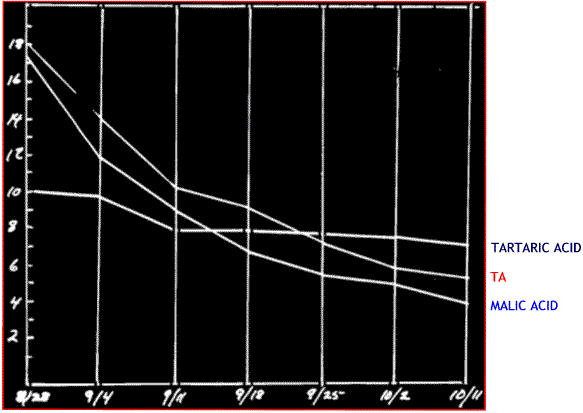
The most frequently encountered problem, if it is a problem, is low pH and high TA. It is not unusual, however, to encounter both high pH and high TA due to a higher concentration of malic acid and high potassium which results in high pH. Under normal growing conditions, some of the malic acid is metabolized into sugars and some disappears through transpiration. And the decrease in TA is directly parallel with the decrease in malic acid. (See graph) Tartaric acid and its salts, on the other hand, remain fairly constant during the ripening process; and ultimately the level of malic acid is metabolized to the point where the dominant acid is tartaric.
One method of dealing with the high pH/high acid phenomenon is the following:
- Add tartaric acid to adjust the tartaric/malic acid balance;
- Use Acidex© to reduce the potassium; and
- Add tartaric acid to achieve the desired pH and TA if necessary.
Since it is unlikely that few, if any, any home winemakers can determine both the tartaric and malic acid levels, it is best to consider the above procedure only in terms of the standard practice of reducing the pH to the desired level prior to fermentation.
A second problem arises when red grapes exhibit both high pH and high TA. Whereas with white grapes it is necessary to press off the juice, make adjustments with Acidex© and add the juice back to the must, this is not practical with red grapes. The best way to deal with red grapes is to add tartaric acid to reduce the pH; use malolactic fermentation to reduce the malic acid; employ cold stabilization; and, if necessary, make further deacidification adjustments with potassium carbonate.
The problem can be dealt with in the same way with those white grape varieties that can be enhanced by malolactic fermentation. However, white grape varieties that depend upon malic acid for their aromas and flavours do not respond well to malolactic fermentation and require other treatments, including the use of higher levels of SO2 to prevent spontaneous malolactic fermentation after bottling.
On the other hand, grapes from warm climates can also exhibit both high pH and high TA. When this situation occurs, the high pH is due to high potassium, and the high TA is almost entirely tartaric. Tartaric acid must be added to reduce the pH, and the necessary acid reduction must be accomplished by using procedures discussed previously. It is unlikely, however, that malolactic fermentation will result in any significant reduction in TA due to very low levels of malic acid.
Index of Acidity (IA) or Acid Taste Index
Ultimately, acid balance is a matter of taste and there is no “rule of thumb” that will determine what the correct acid balance is. However, research has been done that provides some general guidelines that can be helpful in determining whether the acid balance is within the “desired” range for the type and style of wine. It is simply a matter of subtracting the pH from the TA. For example: dry red wines should have an IA range of about 2 to 3, dry white wines about 2.7 to 3.7 and off-dry white wines about 3.8 to 4.8. Too far below these levels and the wine will be flabby or soapy; too far above them and the wine will be sharp and acidic.
Specialty wines such as dry Sherries, sparkling wines, dessert and after dinner wines are not as easy to assess using this method: Sherries because of their general low pH and low TA; sparkling wines because their low pH and high acid are mitigated somewhat by carbonation; dessert and after dinner wines in particular require a much higher pH-to-TA ratio because they usually have a lower pH with higher acids in order to balance the sweetness. Icewines, for example, may have an IA as high as 12 or more. Of significance in red wines is the level of astringency: high astringency will tend to make wines on the high side of the IA seem more acidic than they really are.
While numbers may be useful tools and can be used as aids in striving for good pH/acid balance, the final arbiter of proper balance is the taste buds.
Prepared by Bill Collings
January 27, 2002 (amended June 17, 2007)
Acidex® Calculations
Desired Acidity
| Initial Acidity |
10 g/l | 9 g/l | 8 g/l | 7 g/l | ||||
| Acidex® grams |
Juice litres |
Acidex® grams |
Juice litres |
Acidex® grams |
Juice litres |
Acidex® grams |
Juice litres |
|
| 9.5 g/l | * | * | 8 | 2.8 | 15 | 4.4 | 46 | 8.7 |
| 10.0 g/l | * | * | 15 | 3.6 | 23 | 5.2 | 47 | 9.7 |
| 10.5 g/l | 8 | 2.0 | 23 | 4.4 | 31 | 6.0 | 62 | 10.0 |
| 11.0 g/l | 15 | 2.8 | 31 | 5.2 | 39 | 6.7 | 69 | 10.7 |
| 11.5 g/l | 23 | 3.6 | 39 | 6.0 | 46 | 7.4 | 77 | 11.4 |
| 12.0 g/l | 31 | 4.4 | 46 | 6.7 | 47 | 8.1 | 85 | 12.0 |
| 12.5 g/l | 39 | 5.2 | 47 | 7.4 | 62 | 8.7 | 92 | 12.7 |
| 13.0 g/l | 46 | 6.0 | 62 | 8.1 | 69 | 9.7 | 101 | 13.3 |
| 13.5 g/l | 47 | 6.7 | 69 | 8.7 | 77 | 10.0 | 108 | 14.0 |
| 14.0 g/l | 62 | 7.4 | 77 | 9.7 | 85 | 10.7 | 117 | 14.5 |
| 14.5 g/l | 69 | 8.1 | 85 | 10.0 | 92 | 11.4 | 124 | 14.7 |
| 15.0 g/l | 77 | 8.7 | 92 | 10.7 | 101 | 11.7 | * | * |
Note: The table is set up for 23 litres (5 Imperial gallons) and is calculated for unfermented grape juice. If you are adjusting more than 23 litres of juice divide the Acidex© and juice amounts by 23 and multiply the result by the number of litres you have. Acidex© won’t work if it’s simply dumped into the entire amount of wine. Instead you must add the indicated amount of juice to the Acidex. The procedure is as follows:
- Determine the initial acidity of your juice. Decide the level to which you wish to reduce it and find the correct figures in the table above.
- Carefully measure the juice sample indicated. Do not use more – it won’t work.
- Weigh the indicated amount of Acidex© and place it in a container at least 20% larger in volume than the juice sample. This will allow for foaming.
- Slowly stir the juice into the Acidex©. Stir for at least 10 minutes to thoroughly distribute the acid salts. You should see some active foaming.
- Allow the mixture to settle for several hours, preferably overnight Put it into a refrigerator if possible or, alternately, put it in the coldest place in your wine making area.
- Filter the juice through a lint-free cloth, cheesecloth, or a wine filter. This will remove the chalky precipitate.
- Stir the de-acidified and filtered sample back into the main portion of the juice.
- Test and record your acidity again to ensure your reduction has had the desired effect